
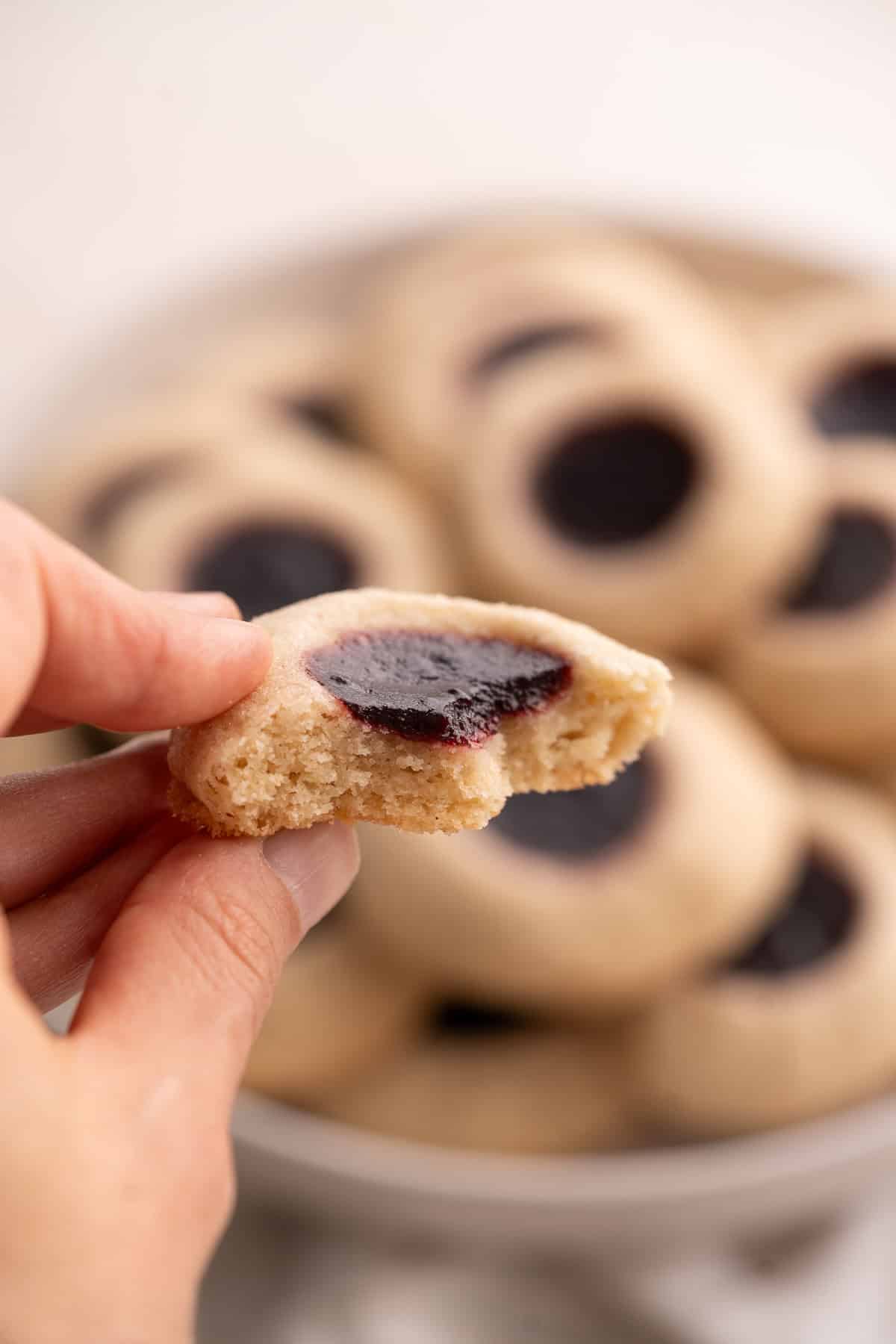
These gluten-free thumbprint cookies are soft, buttery, and melt in your mouth with a sweet jam center and a delicate sugar crust. The dough stays tender while holding its shape, so the cookies bake with smooth edges and far less cracking than the other gluten-free versions I tested.
They're egg-free as written, and both regular butter and dairy-free butter work beautifully. Use dairy milk or plant-based milk depending on what you have-the cookie itself doesn't need an egg substitute or any specialty vegan ingredient.

Recipe Overview: Gluten-Free Thumbprint Cookies
- ⭐ Difficulty: Easy
- 🕒 Total Time: About 1 hour
- 👥 Yield: 24 cookies
- Flavor: Buttery vanilla cookie + fruity jam
- Texture: Soft and melt-in-your-mouth with a lightly crisp sugar coating
- Method: Roll, indent, freeze + bake
- ✅ Diet: Gluten-free + egg-free; easy dairy-free/vegan
⚠️ Most Important Tip: Keep the dough soft and roll each cookie completely smooth before making the indentation. Press slowly and smooth any small cracks closed-the fewer cracks the cookie has going into the oven, the softer and more melt-in-your-mouth it stays as it bakes.
Summarize & Save this Content on:
FEATURED REVIEW ★★★★★
These gluten free thumbprint cookies are the best I tried! They're even better than the ones I used to make before going gluten free. I can't wait to share them at Christmas!
- Crystal
Jump to:
Why This Recipe Works
- Smooth cookies stay softer. I found that gluten-free thumbprints with lots of cracks lose moisture as they bake and end up drier and more brittle. Keeping this dough soft and smoothing the edges around the indentation helps the cookies bake with fewer cracks, giving them their soft, melt-in-your-mouth texture.
- The dough stays tender without falling apart. Potato starch or cornstarch lightens the gluten-free flour blend and helps bind the dough without an egg, so the finished cookies are exceptionally tender but still hold together around the jam.
- No leavener means the thumbprint stays put. There's no baking powder or baking soda, so the cookies don't puff excessively and lose the indentation while baking.
- Freezing sets the shape. Once shaped and indented, the cookies freeze for 30 minutes before filling and baking, which helps them hold their smooth shape in the oven.
Jamie's Note
I tested other gluten-free thumbprint cookies while developing this recipe, and I kept coming back to the same problem: they cracked much more than I wanted and didn't have the soft, melt-in-your-mouth texture I remembered from traditional thumbprints.
I kept this dough intentionally soft and adjusted the starch and chilling method until the cookies held together around the jam while staying exceptionally tender.
Key Ingredients & Substitutions
These gluten-free thumbprint cookies are really easy and require only 9 ingredients! They are also egg-free, dairy-free, and vegan if using dairy-free milk and vegan butter.
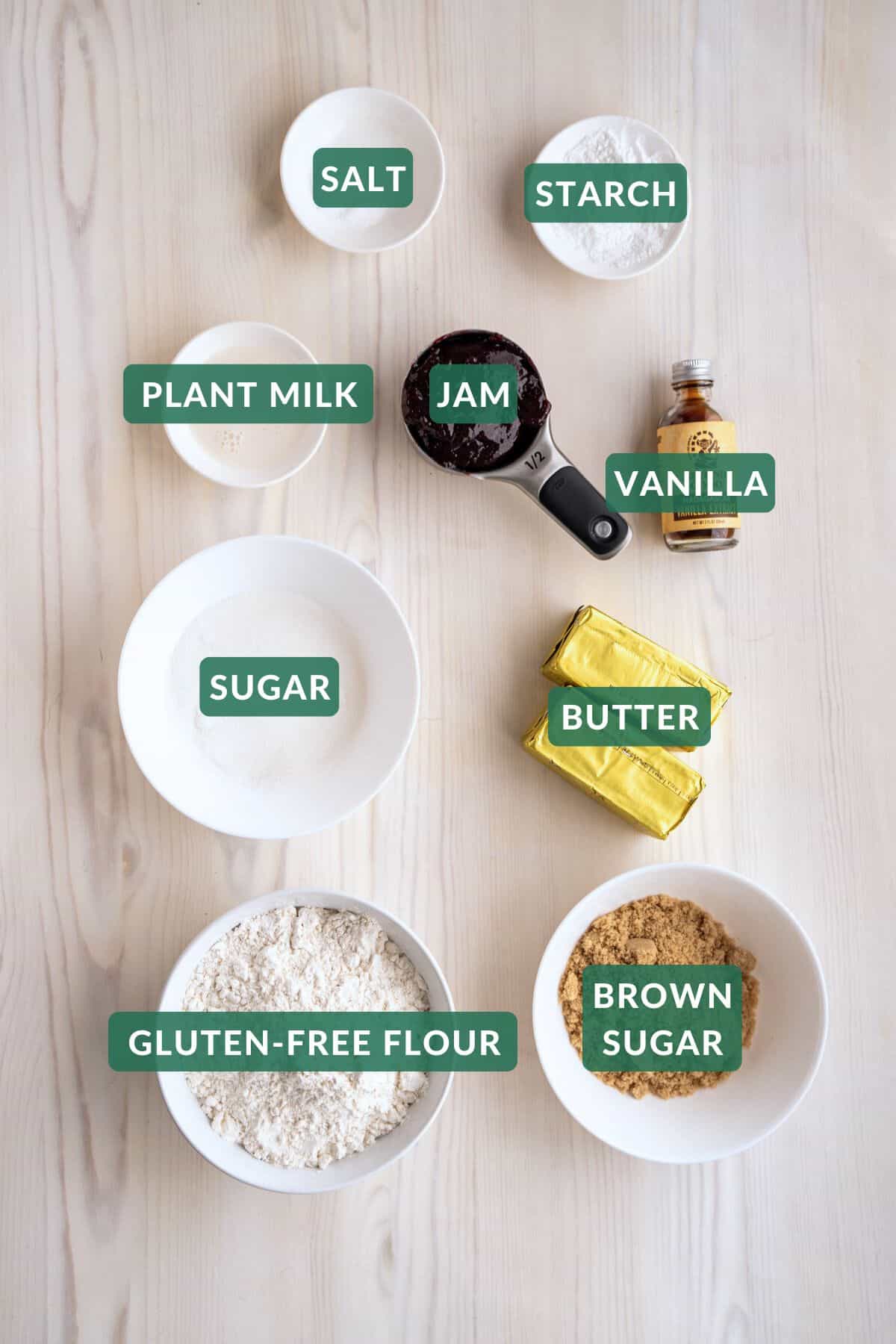
Butter or Vegan Butter
Regular butter and vegan buttery sticks both work well. The cookies shown here were made with Earth Balance Vegan Buttery Sticks. Use whichever fits your needs-there's no need to buy vegan butter if you normally use dairy.
Gluten-Free Flour
I use Bob's Red Mill 1-to-1 Gluten-Free Baking Flour. For the most consistent cookies, I recommend weighing it: I use 275 grams for 2 cups. The blend already contains xanthan gum, so no additional xanthan is needed.
Gluten-free flour blends vary, so substituting another blend can change how soft the dough is and how much the cookies spread or crack.
Starch
Potato starch or cornstarch helps keep the cookies soft and tender while also binding the dough in place of an egg. I've used this technique specifically so the cookie can hold together without becoming firm or dry.
I used Judee's Potato Starch (labeled gluten-free).
Jam
Use a thick jam, jelly, or preserve that you enjoy. I used blackberry jam in the photographed batch and have also tested strawberry. Raspberry is a classic choice for holiday thumbprints. Warming the jam briefly makes it much easier to spoon neatly into the indentations.
I used Crofter's blackberry jam (labeled gluten-free) for these cookies because it's my toddler's favorite.
See the recipe card for full ingredients with quantities.
‼️ Celiac note: Check that the flour and jam you use are gluten-free. Jam jars are also an easy source of cross-contact if a knife used on regular bread has been dipped back into the jar, so I use an uncontaminated jar when baking for someone with celiac disease.
How to Shape Gluten-Free Thumbprint Cookies Without Cracks
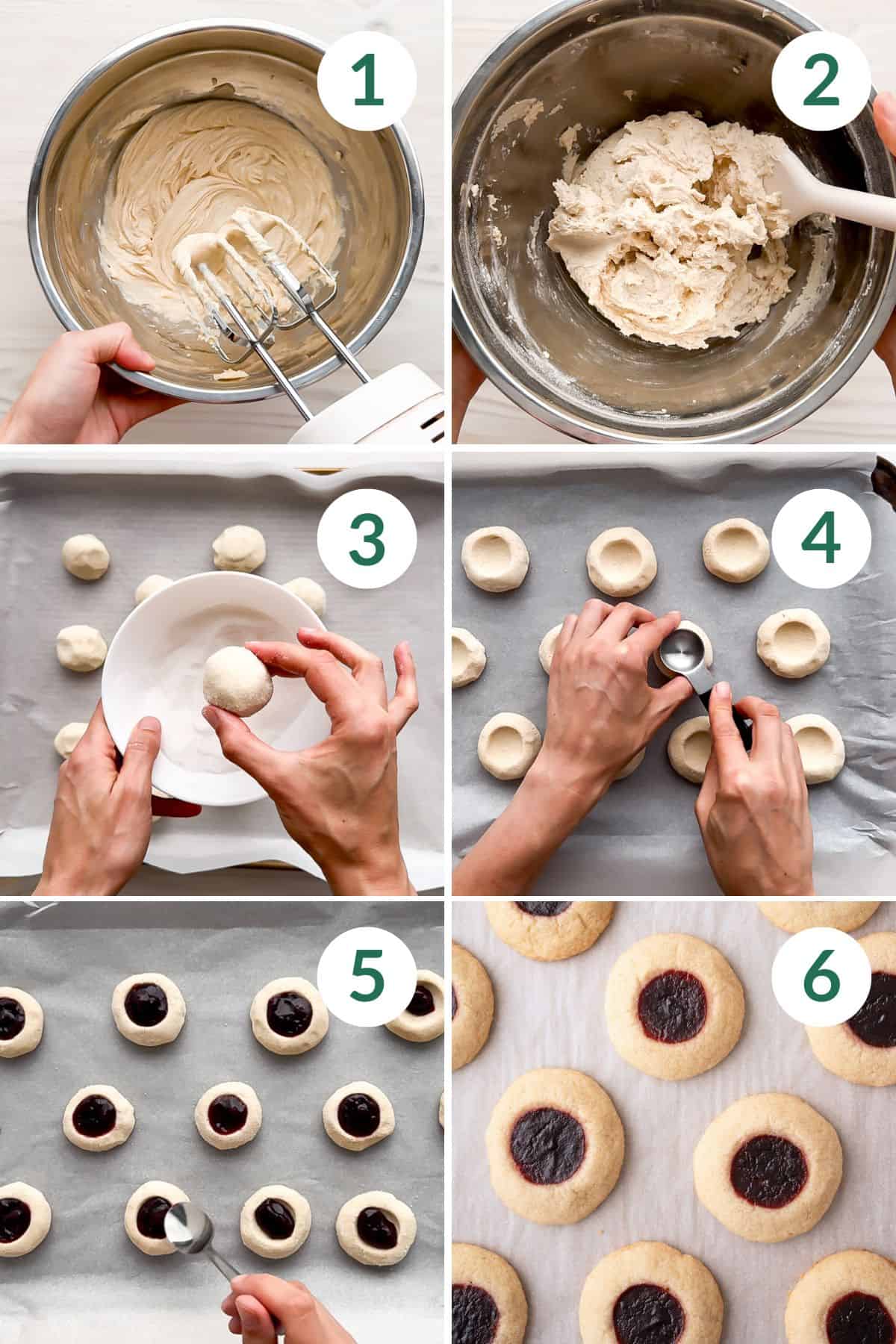
Make a very soft dough. Once the dry ingredients are mixed in, the dough should be soft but cohesive. Don't chill it firm before shaping unless it is genuinely too sticky to handle.
Roll until completely smooth. Portion about 1 tablespoon of dough, roll it between your palms until there are no visible cracks, then coat it in sugar.
Press the indentation slowly. Use your thumb or the back of a 1-teaspoon measure and press only about one-third to halfway through the cookie. Smooth any small cracks closed with your fingers.
Freeze before filling. Freeze the shaped cookies for 30 minutes. Warm the jam briefly, fill the indentations, and bake until the edges are just beginning to turn golden.
Full Step-By-Step Photos
When you make this recipe, please leave a rating and review below. I always appreciate the feedback! ❤️
📖 Recipe

Gluten-Free Thumbprint Cookies
Ingredients
- 1 cup butter or vegan buttery sticks, softened at room temperature (2 sticks, 16 tablespoons)
- ⅓ cup sugar (70 grams)
- ⅓ cup light brown sugar (70 grams)
- 1 tablespoon milk of choice
- ¾ teaspoon vanilla extract
- 2 cups all purpose gluten-free flour with xanthan gum (275 grams)
- 2 tablespoons potato starch or cornstarch
- ½ teaspoon salt
- ⅓ cup sugar for rolling
- ½ cup jam
Instructions
- Wet ingredients: In a large mixing bowl, beat the butter, sugar, brown sugar, milk, and vanilla extract with an electric mixer until smooth and well combined.1 cup butter, ⅓ cup sugar, ⅓ cup light brown sugar, 1 tablespoon milk of choice, ¾ teaspoon vanilla extract
- Make the dough: In a medium mixing bowl, whisk together the gluten-free flour, potato starch, and salt. Then add half the dry mixture to the butter mixture and mix until smooth, scraping down the bowl as needed. Add the remaining dry ingredient mixture and mix thoroughly until a soft dough forms.2 cups all purpose gluten-free flour, 2 tablespoons potato starch, ½ teaspoon salt
- Shape: Scoop 1 tablespoon of dough at a time and roll between your palms until completely smooth. Roll in sugar and place about 2 inches apart on a parchment-lined baking sheet. If the dough is too soft, put it in the refrigerator very briefly to firm up so it's manageable. It's best to keep the dough as soft as you can manage so it doesn't crack when pressing thumbprints.⅓ cup sugar
- Indent and freeze: Slowly press your thumb or the back of a 1-teaspoon measure about one-third to halfway into each cookie. Repair any cracks by gently smoothing the dough with your fingers. Freeze for 30 minutes to firm up.
- Fill: Just before taking the cookies out of the freezer, preheat the oven to 375 degrees F. Warm the jam in the microwave for 10-15 seconds and stir until smooth. Fill each thumbprint to the brim with jam.½ cup jam
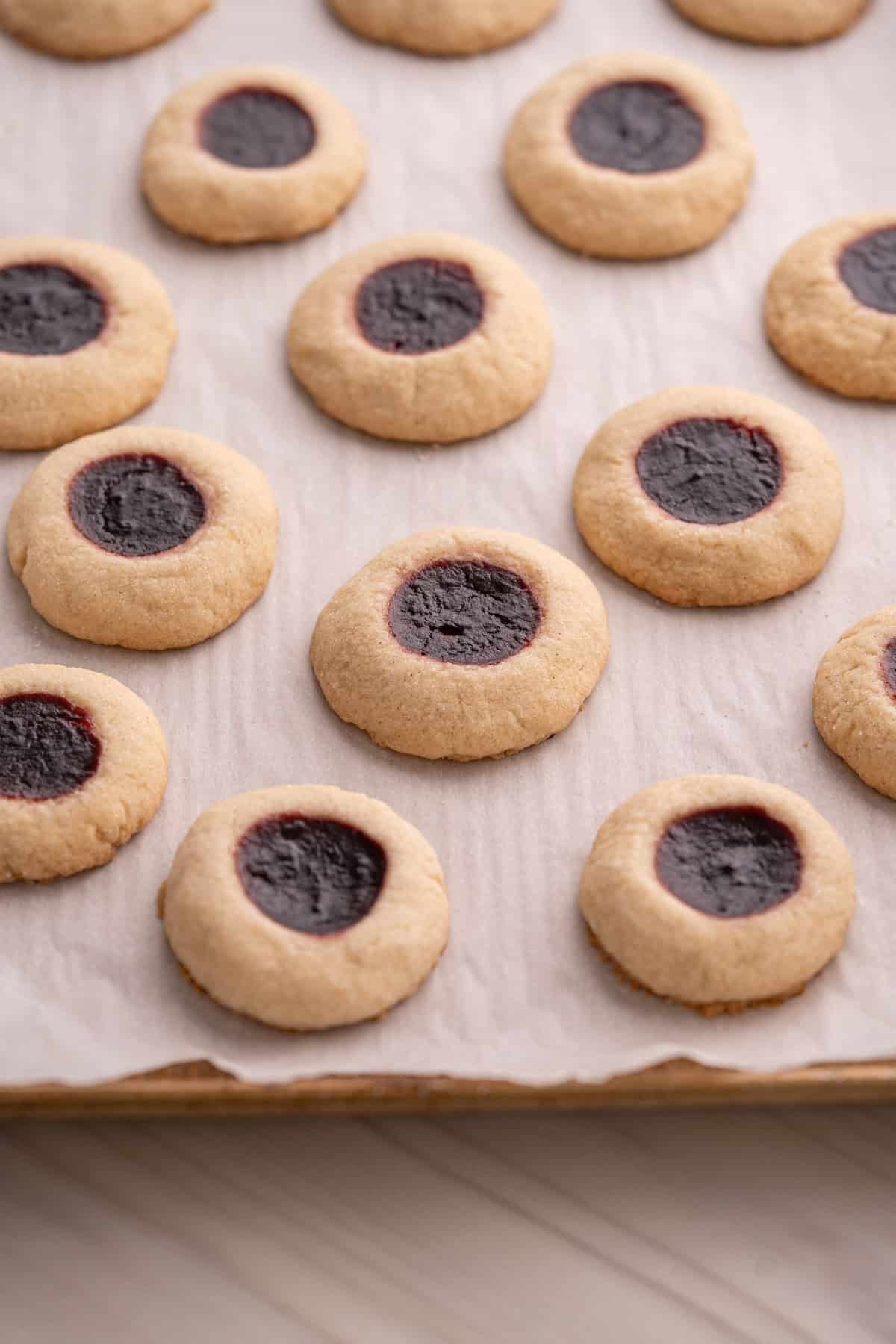
- Bake: Bake for 12 minutes or until the edges are just turning golden brown. Cool completely on the baking sheet.
Notes
Nutrition
Gluten-Free Thumbprint Cookie Recipe FAQs
You do not need to roll these thumbprint cookies in sugar. However, it has a few benefits. Rolling in sugar helps to create a thin sugar crust giving these gluten-free cookies a crisp outside. It also helps to prevent the cookies from sticking to whatever you use to make the thumbprint.
Thumbprint cookies need to hold their shape well with the jam indentation. Baking powder and baking soda cause the cookie dough to expand while baking, and this changes the shape of the cookie.
Instead, the ingredient proportions are changed to create a light and moist cookie. This is also part of the reason why the dough is so soft.





Crystal says
These gluten free thumbprint cookies are the best I tried! They’re even better than the ones I used to make before going gluten free. I can’t wait to share them at Christmas!